The Quick Verdict: Which one should you choose?
If you are short on time, here is the “cheat sheet” to help you decide between Peru’s two most iconic Amazon destinations:
- Choose Manu National Park if: You are looking for a true expedition (5-7 days), want to see the transition from the Andes to the Cloud Forest, rainforest amazon, and prefer raw, untouched wilderness over luxury. It’s the ultimate bucket-list trip for serious nature lovers.
- Choose Tambopata if: You have limited time (3-4 days), are looking for high-end eco-lodges with more comfort, and want easy access via a short flight from Cusco or Lima to Puerto Maldonado.
Accessibility: How to Get to the Heart of the Amazon?
One of the biggest differences between Manu and Tambopata is how you get there. Your choice might depend entirely on how much time you want to spend “on the road” versus “in the jungle.”
Manu National Park: The Scenic Expedition
Getting to Manu is an adventure in itself. Most travelers depart from Cusco, and the journey is a deep dive into Peru’s changing landscapes.
- The Route: You’ll travel by private bus from the Andes (high altitude) down through the mystical Cloud Forest until you reach the lowland rainforest amazon.
- The Journey: Expect a full day (8 to 10 hours) of travel, involving winding mountain roads and a final boat ride to reach your lodge.
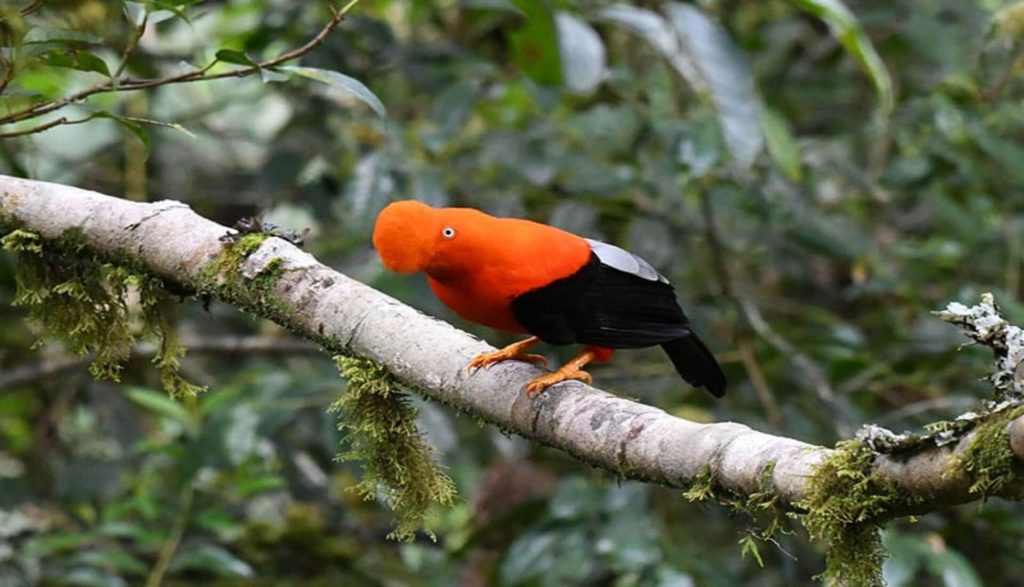
- Why choose this? It’s the only way to see the transition from mountain peaks to tropical jungle, including the habitat of the famous Cock-of-the-Rock.
Tambopata: The Quick Gateway
If you prefer to spend more time spotting monkeys and less time in a van, Tambopata is the winner for convenience.
- The Route: You take a quick 30-60 minute flight from Lima or Cusco to the city of Puerto Maldonado.
- The Journey: From the airport, it’s usually a 15-minute transfer to the river port, followed by a 45-minute to 2-hour motorized canoe ride (depending on the lodge’s location).
- Why choose this? It’s incredibly efficient. You can leave Cusco in the morning and be having lunch in the middle of the Amazon by midday.
💡 Pro-Tip for your Readers:
Traveler’s Note: If you are prone to motion sickness, the road to Manu Jungle Trips can be challenging due to the mountain curves. Tambopata is generally a much “smoother” transition for sensitive stomachs!
Wildlife Comparison: What will you actually see?
While both regions are biodiversity hotspots, the “stars of the show” differ. Manu offers a vast range of ecosystems (from the Andes down to the Amazon), while Tambopata provides some of the most reliable and spectacular close-up wildlife encounters in the world.
🦜 Manu National Park: The Biodiversity Giant
Manu is legendary because it protects an entire watershed from the mountains to the lowlands.
- Andean Cock-of-the-Rock: This is the only place where you can see Peru’s national bird performing its bright red “lek” dance in the Cloud Forest.
- Jaguar Spotting: If you venture into the Manu Reserved Zone, your chances of seeing a Jaguar sunbathing on the riverbanks are among the highest in the world.
- Thirteen Primate Species: From the tiny Pygmy Marmoset to the large Spider Monkey, Manu has a higher density of monkey species.
- Pristine Ecosystems: Because it’s so remote, the animals here are “wilder” and less accustomed to humans, offering a very authentic experience.
🐒 Tambopata: The Land of the Clay Licks
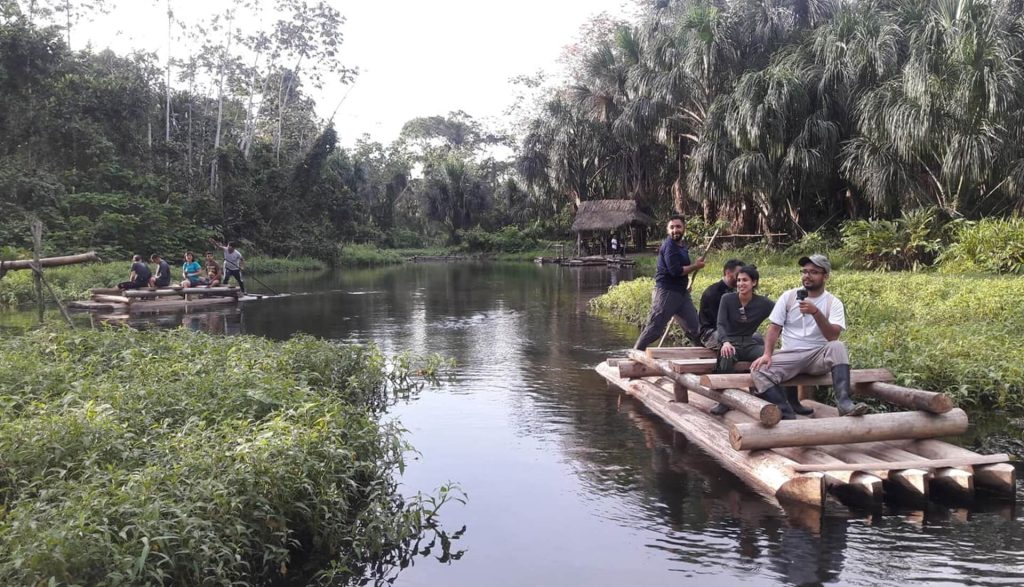
Tambopata is famous for its “Colpas” (clay licks) and its incredible oxbow lakes.
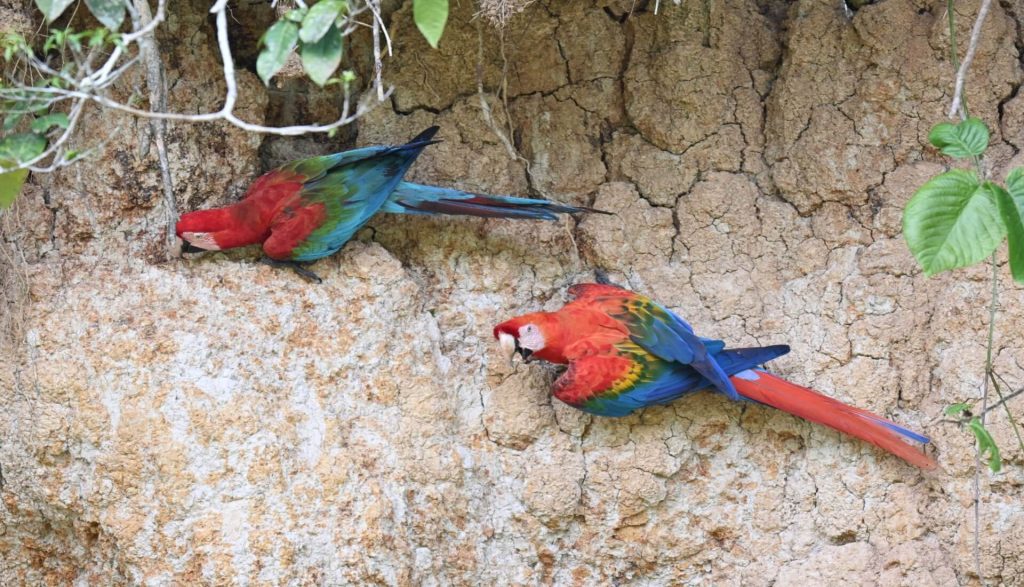
- Macaw Clay Licks: Witnessing hundreds of colorful Macaws and Parrots feeding on the clay cliffs at sunrise is a world-class spectacle unique to this region.
- Giant River Otters: Lake Sandoval is home to a resident family of these “wolves of the river.” Sightings here are almost guaranteed and very close-up.
- Ease of Sightings: Since the forest is flatter and the lodges are well-established, guides have “monitored” areas where finding sloths, caimans, and monkeys is very efficient.
- Night Walks: Tambopata is excellent for “macro” wildlife, like colorful frogs, rare spiders, and nocturnal insects.
💡 Quick Summary for Travelers:
- Choose Manu if: You are a hardcore birder or photographer looking for rare species and “deep jungle” vibes.
- Choose Tambopata if: You want to see the “Big Stars” (Macaws, Otters, Monkeys) in a shorter amount of time and with less travel effort.
Costs and Logistics 2026: Planning Your Amazon Budget
When it comes to the Peruvian Amazon, the price tag is often the deciding factor. However, “cheap” doesn’t always mean “better” in the jungle, as logistics play a massive role in the final cost.
Tambopata: The Budget-Friendly and Flexible Choice
Tambopata is generally more affordable for the average traveler, mainly because of its proximity to Puerto Maldonado, a major hub with high competition among tour operators.
- Accommodation Variety: You can find everything from backpacker-style eco-hostels for $70 – $90 USD per night (including meals and tours) to ultra-luxury lodges like Inkaterra or Posada Amazonas that can go up to $400+ USD per night.
- Transportation Savings: Since you can fly into Puerto Maldonado from Cusco or Lima in under an hour, you save on “travel days.” You aren’t paying for a guide and driver to transport you for 10 hours across the Andes.
- Last-Minute Bookings: Because there are so many lodges, it’s easier to find a spot just a few days before your trip, which often leads to “last-minute” discounts.
Manu National Park: The Investment in Remote Wilderness
Manu is typically more expensive, not because it’s “luxurious,” but because of the extreme logistics required to reach the Reserved Zone.
- The Expedition Cost: A high-quality 6-day tour to the Manu Reserved Zone usually starts around $800 – $1,200 USD. This covers the long-distance private transport, boat fuel (which is expensive in remote areas), and park entrance fees.
- The “Cultural Zone” Alternative: If you are on a tight budget, you can visit the Manu Cultural Zone (the outskirts of the park) for about $400 – $500 USD for 4 days. However, keep in mind that wildlife spotting here is significantly lower than in the deeper Reserved Zone.
- Logistical Complexity: In Manu, you are paying for the “remoteness.” Most lodges are family-owned or run by conservation groups, meaning you are directly supporting local biodiversity protection.
Time Investment: How Many Days Do You Really Need?
Time is the most precious resource for anyone visiting Peru. Here is how to manage your itinerary for 2026:
The “Add-on” Strategy: Tambopata (3-4 Days)
Tambopata is the perfect “side dish” to a trip to Machu Picchu.
- Day 1: Fly from Cusco, arrive at the lodge by lunch, afternoon jungle walk.
- Day 2: Full day at Lake Sandoval or a Macaw Clay Lick.
- Day 3: Canopy walk and return to the airport.
- Verdict: If you only have a week in Peru, Tambopata allows you to see the Amazon without sacrificing other highlights.
The “Deep Dive”: Manu (5-9 Days)
Visiting Manu for 3 days is, quite frankly, a waste of time and money.
- The Journey is the Destination: You spend at least 1.5 days just getting into the heart of the park.
- The Sweet Spot: A 6-day/5-night itinerary is the minimum recommended. This gives you 2 full days in the Reserved Zone, where the Jaguars and Giant Otters are most active.
- Verdict: Manu is for the traveler who wants to “disconnect” from the world and doesn’t mind spending hours on a boat watching the riverbanks for wildlife.
Best Time to Visit (Weather Patterns & Seasons)
The Amazon doesn’t have “Summer” or “Winter”; it has “Wet” and “Dry.” Choosing the right month in 2026 will define your entire experience.
The Dry Season (May to October): The Gold Standard
This is peak season for a reason. The weather is more predictable, and wildlife is easier to find.
- Wildlife Activity: As water levels drop, animals congregate around the remaining water holes and riverbanks. This is the best time for Jaguar spotting in Manu.
- Hiking Conditions: Trails are less muddy, and there are fewer mosquitoes (though they never truly disappear!).
- The “Friajes”: Between June and August, cold fronts from the south can hit the Amazon, dropping temperatures to 10°C (50°F) for a few days. Pack layers!
The Wet Season (November to April): The Flooded Forest
Don’t let the word “Rainy” scare you off. The Amazon is beautiful when it’s lush and green.
- The Flooded Forest: You can navigate deeper into the forest by canoe, reaching areas that are inaccessible in the dry season.
- Birding Paradise: Many birds are more active and easier to spot against the vibrant green canopy.
- The Downside: Expect heavy downpours that can last for hours, delayed flights in Puerto Maldonado, and very muddy trails.
- Note for Manu: Landslides on the road from Cusco to Manu are common in January and February, sometimes causing travel delays.
💡 Final Recommendation: Which one should you book for 2026?
- Choose Tambopata if: You want comfort, great photos of Macaws, and you are traveling with family or have a tight schedule.
- Choose Manu if: You are an adventurer, a birdwatcher, or someone who wants to see the “pristine” Amazon as it was thousands of years ago, far from the reach of modern civilization.
Which Amazon Adventure Will You Choose for 2026?
Deciding between Manu National Park and Tambopata National Reserve isn’t about finding which one is “better,” but which one fits your travel style.
- If you are a photographer or a family traveler looking for efficiency, comfort, and guaranteed sightings of Macaws and Giant Otters, Tambopata is your best bet.
- If you are an explorer at heart, a birding enthusiast, or someone who wants to experience the raw, untouched scale of the Amazon from the Andes to the lowlands, Manu will change your life.
Whichever you choose, the Peruvian Amazon is one of the most biodiverse places on Earth. Visiting these reserves isn’t just a vacation—it’s a way to support conservation efforts that protect “the lungs of the world” for future generations.
💬 I Want to Hear From You!
Planning a trip to Peru in 2026 and still can’t decide? Or perhaps you’ve already visited one of these incredible places?
Leave a comment below with your questions or share your favorite Amazon memory! I read every single one and I’m happy to help you plan the perfect jungle itinerary.
Don’t forget to share this guide with your travel partners to see which adventure they prefer!
Comments are closed